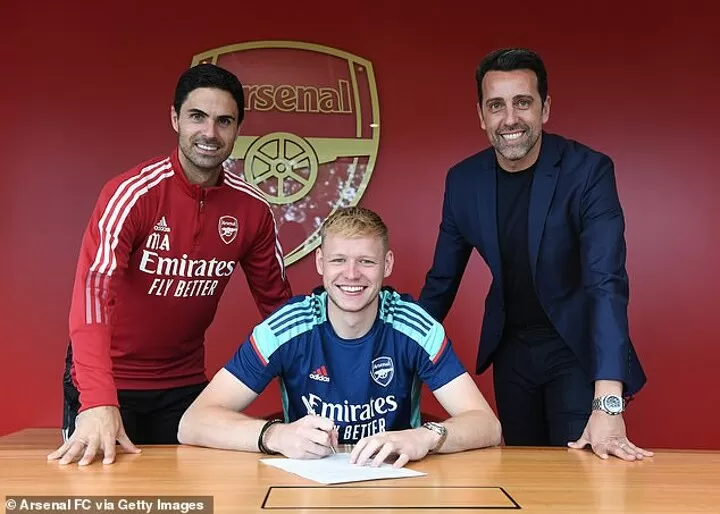
Arsenal will narrowly stay within Financial Fair Play spending limits, financial analysts expect, despite being placed on a watchlist by the European football governing body, UEFA.

It is understood that 20 clubs across Europe have been identified by UEFA as at risk of breaching FFP regulations in the year 2021-22, including the Gunners.
If found to have broken the rules, clubs can be warned or sanctioned, which includes fines, relegation to a lower level of European competition or even complete exclusion.
Arsenal, who will compete in the Europa League this season, insist they run the club in compliance with Financial Fair Play and say there has been no contact from UEFA on the subject.
‘On balance, I think they will be just about OK, and if not they will jonly just be the wrong side of it,’ Dr Rob Wilson, a football finance expert at Sheffield Hallam University told Sportsmail, after considering Arsenal’s financial dealings last season.
A minor breach and first offence is unlikely to result in any sanction, said Dr Wilson.
UEFA has not yet received the accounts for last season from Arsenal, or other clubs on the watchlist, which will be required to calculate wheher rules have indeed been broken.
The Gunners have attracted attention after posting big losses in 2019-20 and 2020-21 seasons and spending £260M on a dozen new players in the last two years, including Oleksandr Zinchenko and Gabriel Jesus, this summer.

In terms of net expenditure, Arsenal have spent more than Chelsea, as the club backs manager Mikel Arteta to restore former glories.
Meanwhile, UEFA is preparing to announce sanctions against Barcelona, Paris Saint-Germain, Juventus, Inter Milan and Roma for breaking its FFP regulations, last year, according to The Times.
So what are UEFA’s FFP rules, how much is a club allowed to spend and how will Arsenal escape censure despite huge transfer spending? Sportsmail explains.
What are the UEFA FFP rules?
The bean counters at the European football governing body have kept a beady eye on big spending in the transfer market this summer, and they figure some clubs are already close to their allowable limits, with a week of trading still to go.
Like in the Premier League, UEFA has rules, which have been put in place to at least try to maintain a level playing field in European competitions, including the Champions League, Europa League and Europa Conference League.
In fact, UEFA’s regulations are even stricter than those in the English top flight. From this summer, the allowable losses – or the ‘acceptable deviation’ as the accountants put it – are just over £50M (or 60M Euros), compared to £105M in the Prem.

The number-crunchers in the Swiss town of Nyon, where UEFA is based, don’t know which clubs will breach the rules this year until they see the accounts for the 2021-22 season, but they have a good idea about who is flying close to the wind.
And those clubs that have racked up losses in the past two years and continue to go large in the market have found themselves on a watchlist. Essentially, it’s a warning; a light touch on the collar of the chairman to say ‘we are very much looking forward to seeing your accounts’. The hope is that those at risk of breaching the rules row back.
So, which clubs are on the watchlist?
It is not a published list, but Arsenal is one club understood to be on it.
The Gunners have attracted the attention of the UEFA after recording significant post-tax losses amounting to £155.1M in the 2019-20 and 2020-21 seasons combined.
Officials need last season’s accounts – 2021-22 – to work out if Arsenal have actually broken the rules, but their interest appears to have been piqued by the club’s extravagant transfer spending on top of historical losses.
Arsenal have spent £113m this summer on Gabriel Jesus, Fabio Vieira, Oleksandr Zinchenko, Matt Turner and Marquinhos, while 2021/22 included £147m on Ben White, Martin Odegaard, Aaron Ramsdale, Takehiro Tomiyasu, Albert Sambi Lokonga, Nuno Tavares and Auston Trusty.
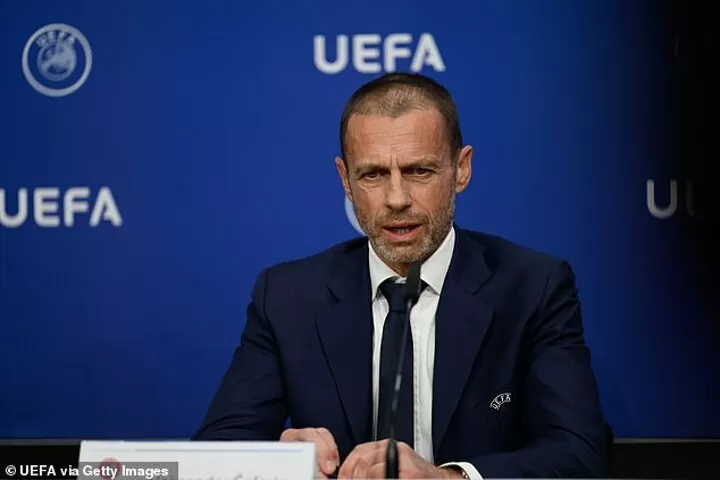
It marks a big shift in the Gunners’ strategy after a period thrift, the club is now all in to support Arteta by bringing in good, young players who can take the team back to the top four – and Champions League football – on a regular basis.
The net transfer spend works out at £218m over the two years and remarkable that is the highest among the the Big Six clubs in the last two seasons, according to respected football financial analyst Swiss Ramble on Twitter.
What happens if a club breaks the UEFA FFP rules?
As ever, there is a long list of possible punishments and the actual sanction will depend upon the severity of the offence and whether the club has erred before.
The options for the UEFA Club Financial Control Body include: a warning, fines, demotion from one European competition to another and even exclusion.
What does it mean for the Gunners?
‘On the face of it, things don’t look too good for Arsenal,’ Swiss Ramble suggested on Twitter.
But in fact, in his analysis and according to other experts spoken to by Sportsmail, Arsenal will probably be OK.
Crucially, UEFA calculations allow expenditure related to Covid and ‘healthy spending’ on infrastructure, women’s football, acadmies and community programmes to be deducted from the overall losses.